
Heat Pump vs. Furnace – Which is Best for Your Home?

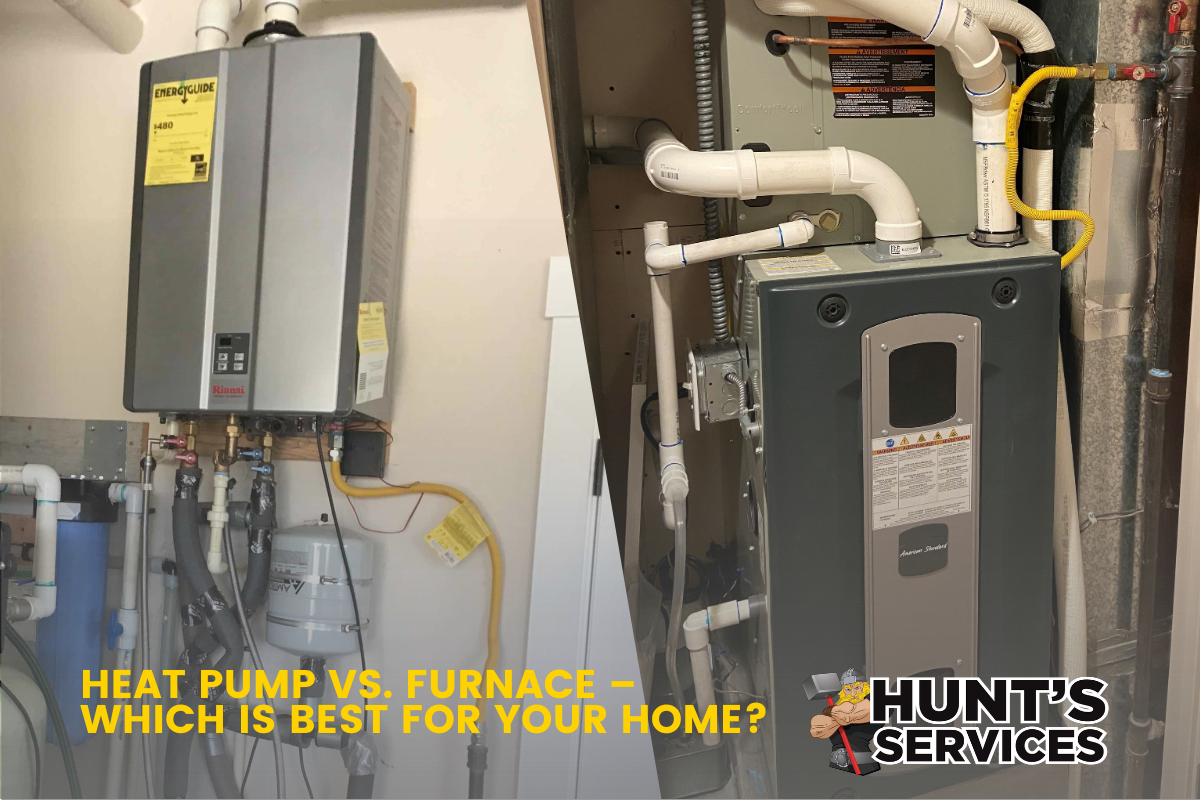
Heat pump and furnace side-by-side comparison in a home HVAC system, featuring visible plumbing and installation details, with "HEAT PUMP VS. FURNACE – WHICH IS BEST FOR YOUR HOME?" text overlay and Hunt's Services logo.

If you’re building a new home or replacing an aging HVAC system, one of your most significant decisions is using a heat pump or a furnace. The right choice depends on your local climate, energy efficiency goals, and overall budget.

This guide compares each system’s cost, efficiency, and pros and cons to help Tacoma-area homeowners make an informed decision.

Comparing Cost & Efficiency

Upfront & Operating Costs

Furnacestypically have a lower upfront cost. Depending on the fuel source (natural gas, electric, or propane), the installation cost for a basic furnace system in Tacoma can range from $3,000 to $6,000. Furnaces are also simple to maintain, keeping long-term servicing costs relatively low.

On the other hand, heat pumps have a higher upfront installation cost—usually $4,000 to $10,000, depending on the system type (ducted vs. ductless) and home size. However, heat pumps provide heating and cooling, eliminating the need for a separate air conditioner, potentially offsetting some of the installation expense.

Heat pumps are significantly more energy efficient in terms of operating cost, especially in milder temperatures. According to the U.S. Department of Energy, homeowners switching to heat pumps from older gas or electric furnaces can save up to 50%on their heating bills.

Explore local furnace efficiency standards

Energy Usage by Climate

Your geographic locationmatters most here. Heat pumps perform well year-round in moderate climates like Tacoma, where winters are cold but not extreme. They’re exceptionally efficient when temperatures hover above freezing during spring and fall.

However, furnaces maintain an edge in regions that experience long, deep freezes. Gas furnaces can consistently produce high heat output, even in subzero temperatures, while standard heat pumps become less efficient.

That said, modern cold-climate heat pumpscan now operate effectively in temperatures as low as -5°F, making them viable even in colder areas—especially when paired with a backup heating source.

Pros and Cons of Each System

Pros of Heat Pumps

  • Dual function: Offers both heating and air conditioning
  • High energy efficiency: Uses electricity to transfer heat rather than generate it
  • Lower carbon emissions: Especially when paired with clean electricity
  • Incentives: May qualify for federal tax credits and local rebates
  • Even heat distribution: Avoids hot and cold spots common with forced air

Learn about ductless mini-split systems

Cons of Heat Pumps

  • Higher upfront cost
  • May struggle in extreme cold (unless it’s a cold-climate model)
  • Can require electrical upgrades if switching from gas

Pros of Furnaces

  • Lower initial cost
  • Quick, powerful heat output– ideal for cold snaps
  • Familiar technology: Widely available parts and service providers
  • Works well with existing ductwork

Schedule furnace repairs in Tacoma

Cons of Furnaces

  • Requires a separate AC system for cooling
  • Less energy efficient (especially older gas models)
  • More greenhouse gas emissions (in gas-powered units)
  • Can dry out indoor air

Key Decision Factors: Which Should You Choose?

Here’s a side-by-side comparison to make the choice easier:

FeatureHeat PumpFurnace
Initial Installation CostHigherLower
Heating EfficiencyHigh (especially in mild climates)High in cold climates
Cooling CapabilityYes (built-in)No (requires separate AC unit)
Environmental ImpactLower (especially electric models)Higher (especially gas models)
Maintenance NeedsSeasonal service recommendedSeasonal service recommended
Incentives AvailableYes (federal/state rebates)Fewer incentives available

Tacoma-Specific Rebates and Incentives

Washington residents may qualify for several rebates when installing high-efficiency HVAC systems:

  • Federal Inflation Reduction Actincentives for ENERGY STAR-certified heat pumps

  • Puget Sound Energy (PSE)rebates for heat pump conversions and ductless mini-split installations

  • Tacoma Powerrebates for ductless and central heat pumps

Checklocal incentivesor ask a Hunt’s Services technician for details.

Let Hunt’s Help You Choose

Whether you’re drawn to a heat pump’s year-round efficiency or the reliability of a traditional furnace, Hunt’s Services is here to help.

Our licensed HVAC professionals evaluate:

  • Your home’s insulation and ductwork
  • Local Tacoma climate factors
  • Your energy goals and available rebates

We’ll recommend the best-fit system to maximize your comfort and energy savings. We also offer financing optionsand Care Club maintenance plansfor long-term protection.

Contact Hunt’s Services Today
See Our Customer Reviews
Learn About HVAC Installations

FAQs

1. What’s cheaper to run, a furnace or a heat pump?

Heat pumps are cheaper to run in moderate climates like Tacoma due to their higher energy efficiency. They transfer heat rather than generate it, which uses less electricity.

2. Will a heat pump work during freezing weather?

Yes, especially cold-climate-rated heat pumpsoperate efficiently down to -5°F. In icy areas, a backup heat source (like electric resistance coils or a gas furnace) may still be recommended.

3. Can I replace my furnace with a heat pump?

Yes. Many homeowners are switching from gas or electric furnaces to heat pumps. Hunt’s Services can inspect your electrical panel, ductwork, and insulation to determine what upgrades may be needed for a successful transition.

How Heat Pumps Save Seattle Homeowners Money Year-Round

Heat pump installation by Hunt's Services, showcasing energy-efficient HVAC solutions for Seattle homeowners, with accompanying text emphasizing cost savings year-round.

Seattle’s Energy Costs and Why Heat Pumps Are Trending

Seattle homeowners know the challenge of balancing comfort with rising utility bills. Electricity and natural gas costs in Washington have steadily increased, which leaves many households searching for smarter, more efficient solutions.

That’s where heat pumpscome in. Once seen as a niche option, heat pumps are now a mainstream choice for eco-conscious families across the Puget Sound. Seattle’s relatively mild winters and cool summers deliver cost savings year-round while aligning with the city’s commitment to sustainable living.

Unlike traditional furnaces that only provide heat, heat pumps work as two-in-one systems—heating and cooling your home. For “Efficiency Ethan,” the eco-smart Seattle homeowner, a heat pump is more than an upgrade. It’s an investment in lower bills, a smaller carbon footprint, and a more comfortable home.

How Heat Pumps Work

A heat pump doesn’t burn fuel like a furnace. Instead, it moves heat from one place to another using electricity.

  • In winter, the system extracts heat from outdoor air and transfers it indoors, even when it iscold outside.
  • In summer,it reverses the process, pulling heat out of your home to keep it cool.

Because a heat pump moves heat rather than generating it, the system is 3 to 4 times more efficientthan traditional heating. This efficiency translates directly into reduced energy consumption and noticeable monthly savings.

Heat Pumps vs. Furnaces: The Efficiency Advantage

When comparing heating options, the efficiency gap is apparent. A standard gas furnace typically operates at 80–90% efficiency, meaning up to 20% of the energy is lostduring combustion. In contrast, modern heat pumps don’t generate heat — they move it — allowing them to achieve efficiencies of 200% to over 300%, especially in Seattle’s mild climate. That means for every unit of electricity consumed, a heat pump can deliver 2 to 3 units of heat, offering a significant performance edge and energy savings over traditional systems.

Seasonal Cost Savings in Seattle’s Climate

Seattle is uniquely suited for heat pumps. Here’s why:

  1. Mild Winters:Unlike colder regions, Seattle rarely sees prolonged sub-freezing temperatures. This means heat pumps can run efficiently without over-relying on backup systems.

  2. Cool Summers:With more frequent heat waves hitting the Puget Sound, air conditioning demand is climbing. A heat pump provides efficient cooling without the cost of a separate AC unit.

  3. Energy Rebates and Incentives:Washington state and local utilities often offer rebates for upgrading to energy-efficient heating, further reducing upfront costs.

According to the U.S. Department of Energy, homeowners can cut heating and cooling bills by 30–40%with a high-efficiency heat pump. In Seattle, that can add up to hundreds of dollars saved annually.

Imagine replacing a $250 monthly winter gas bill with a $150 electric bill. Over the course of a year, those savings add up quickly.

Efficiency Benefits vs. Traditional HVAC

Heat pumps offer more than just cost savings. They’re also a cleaner, healthier option for Seattle homes:

  • Energy-efficient heating:Uses electricity instead of fossil fuels, reducing greenhouse gas emissions.

  • Better air quality:Many heat pump systems have advanced filtration that helps reduce allergens, pollen, and dust—important for Seattle’s allergy seasons.

  • All-in-one solution:One unit replaces your furnace and air conditioner, saving space and simplifying maintenance.

  • Reduced wear and tear:Heat pumps generally require fewer repairs than traditional gas systems because they don’t rely on combustion.

For “Efficiency Ethan,” the forward-thinking homeowner persona, this aligns perfectly with his desire for modern, low-impact technology that saves money and benefits the planet.

Upfront Cost vs. Long-Term ROI

One of the most common concerns homeowners have is cost. A heat pump installation is often more expensive than replacing a furnace upfront. But here’s why the return on investment is worth it:

  • Lower operating costs:Monthly utility bills drop immediately after installation.
  • Rebates and tax credits:Incentives can significantly reduce the price.
  • Longevity:Heat pumps often last 15–20 yearswith proper maintenance.
  • Higher resale value:Energy-efficient homes sell faster and for more money in Seattle’s competitive housing market.

Think of a heat pump as a financial investment. While a gas furnace might be cheaper to install, the long-term ROI heavily favors heat pumpsonce you factor in energy savings, maintenance costs, and environmental benefits.

Why Choose Hunt’s Services for Your Heat Pump Installation

Hunt’s Services is trusted for reliable HVAC solutions in Seattle and Tacoma. With years of experience installing heat pumps in Washington homes, we help customers maximize rebates, choose the right system size, and ensure long-term performance.

  • Licensed, bonded, and insured technicians
  • Transparent pricing with no hidden fees
  • Expertise in both ducted and ductless systems
  • Local service you can rely on year after year

Hunt’s Care Club members get seasonal tune-ups, priority service, and repair discounts, making maintenance effortless.

Learn more about Hunt’s Care Club

Seattle’s climate makes heat pumps the wise, money-saving choice for modern homeowners. If you’re ready to cut heating and cooling costs while boosting efficiency, now is the time to act.

Book your free heat pump consultation with Hunt’s Services todayand start saving year-round.

Frequently Asked Questions

Q1: How much can I save with a heat pump in Seattle?
Most Seattle homeowners save 30–40% on annual heating and cooling costscompared to older furnaces and AC systems, depending on home size and usage.

Q2: Do heat pumps work in Seattle winters?
Yes. Seattle’s moderate winter temperatures are ideal for heat pumps. They efficiently extract heat even on chilly days without needing heavy backup heating.

Q3: What rebates are available for heat pump installation?
Seattle-area homeowners can access state rebates, utility incentives, and federal tax credits. Hunt’s Services helps customers maximize these savings to reduce upfront costs.

How Do Heat Pumps Work?

Ductless heat pump units mounted on a wall, showcasing energy-efficient HVAC technology for home comfort in Tacoma, WA.

In the residential HVAC world, one of the newest products to hit the market is the extremely efficient heat pump. Due to its name, many homeowners assume that it can only heat their homes. However, it can also cool your home in the summertime.

Why Is It Called a Heat Pump?

First and foremost, it will help to address why this system is called a heat pump. This will allow us to clear up any confusion about whether it heats or cools your home. This type of system is referred to as a heat pump because it pumps heat in a specified direction. During the wintertime, a heat pump will transfer heat from the outside air to the inside of your home. During the summertime, a heat pump will extract heat from a warm room and transfer the radiant energy to outside your home.

The Different Types of Heat Pumps

It’s important to note that heat pumps are just a broader category that can be divided into two smaller categories. These include air-source and geothermal heat pumps. With air-source heat pumps, heat is extracted from the air. On the other hand, geothermal heat pumps transfer heat from the water or the ground. You may hear geothermal heat pumps referred to as ground-source or water-source heat pumps, depending on the substance they extract heat from.

How Does an Air-Source Heat Pump Operate?

Since not all properties can accommodate a geothermal heat pump, we’re going to spend the majority of our time discussing air-source heat pumps. These are the most common types of heat pumps installed in residential settings. Each air-source heat pump will have five main components.

Outdoor Unit

All air-source heat pumps will have an outdoor unit with a coil and a fan. Typically placed right next to the exterior of your home, this outdoor unit works to blow the outside air on the coils to facilitate heat transfer.

Indoor Unit

The indoor unit is also called the air handler unit, and this component contains a fan and coil. This fan works in much the same way as in the outdoor unit. It blows inside air on the coils to transfer heat in the desired direction.

Refrigerant

The lifeblood of any air-source heat pump is refrigerant. This substance works to absorb heat. Refrigerant is pumped throughout the entire heat pump system to transfer heat either indoors or outside.

Compressor

The compressor increases the pressure and temperature of the refrigerant.

Valves

The last component of an air source heat pump is its valves. There is an expansion valve, which regulates the flow of refrigerant as it goes throughout the system. It’s responsible for helping to reduce the pressure of the refrigerant. The second valve is called the reversing valve. This component is responsible for reversing the flow of refrigerant so that you can switch between heating or cooling your home.

How Does a Heat Pump Cool My Home?

The process of cooling of your home with a heat pump starts with the fan on the indoor air handler blowing the warm room air across the coils. These coils are filled with a cold liquid refrigerant. Because heat energy naturally moves from warmer to cooler areas, the cold refrigerant will naturally attract heat from the warm air that is blown over the coil. This results in heated refrigerant and the now-cold air. This conditioned air is sent back into your home via your ducting or your ductless system.

The refrigerant heats up after it absorbs the heat energy from the room and turns into a gas. This gaseous refrigerant is now forced through the compressor where it becomes even hotter and flows to the outside unit. Similarly to the inside unit, the outside unit will run a fan over the coil that is filled with the hot gaseous refrigerant. Since the outside air is cooler than the hot refrigerant, the heat from the refrigerant will naturally be dispersed into the air outside.

When this process happens, the refrigerant turns back from a gaseous state to a liquid state. The refrigerant liquid is pumped back into the house through an expansion valve. This expansion valve reduces the pressure of the refrigerant and cools it significantly. Once the refrigerant is cold again, it’s pumped back into the coil in the indoor unit, and the process starts all over again.

Your heat pump will continue to work until the inside temperature of your home matches what your settings are on your thermostat. It’s crucial to note that heat pumps utilize a basic thermostat like your furnace or central air conditioning unit does. You need to set your desired temperature, and your heat pump will take care of getting the air inside your home to that temperature.

How Does a Heat Pump Heat My Home?

In the wintertime, your heat pump will utilize a very similar process that we discussed above. However, it will do this process in reverse thanks to its reversing valve. The outdoor unit will blow air across its coils that are filled with refrigerant that is colder than the outdoor air. The refrigerant absorbs heat from the warmer air and is pumped indoors. It then travels through the compressor and vaporizes into a hot gas. When it arrives at the indoor unit, a fan blows heat energy out of the refrigerant and into your cooler home. The now-cooled refrigerant travels through the expansion valve, loses pressure, becomes colder and is pumped into the outdoor coil where it absorbs heat from the warmer outside air. This process repeats itself until your home reaches your desired indoor temperature.

Ducted and Ductless Heat Pumps

When you first start analyzing air source heat pumps, you’ll notice that there are two different types of offerings. These include ducted and ductless systems. The difference between the two is how the treated air is dispersed throughout your home.

When you think of a typical HVAC system, most of them include ductwork. This means that air ducts run throughout the walls and floors of your home. They disperse warm or cold air via vents. With this type of system, an indoor handler unit can be placed in a hidden area of the home, such as your basement or utility closet.

The other type of heat pump system is the ductless system. These are commonly referred to as mini-split systems. Instead of having ductwork run throughout your home, these systems use wall-mounted units to disperse warm or cold air into each main room of your home. Each wall-mounted unit will be connected to refrigerant lines that go to the outdoor unit of your home. Ductless mini-split units are more common in existing homes without ducting or for room additions in a ducted home.

Rely on the Pros

When you are looking for heat pump experts for your home in Tacoma, look no further than Hunt’s Services. We offer a wide variety of services, including plumbing, heating, cooling, water filtration, sewer, drain, electrical, and indoor air quality products. Contact Hunt’s Services today, and we’ll get one of our experienced professionals on the way to your home.

New Incentives Make Heat Pumps More Affordable For Washington Residents

Updated: August 10, 2023

When the Inflation Reduction Act (IRA) was signed into law on August 16, 2022, it included the most ambitious climate action policies in American history.

The IRA aims to cut domestic greenhouse gas emissions in half by 2030 compared to 2005 levels, but significant changes to the way we live will become necessary.

Americans can help the country reach its goals by switching to electric energy whenever possible. Fossil fuels are responsible for about 73% of greenhouse gas emissions in the country, so limiting their use will be critical.

Using a heat pump to heat and cool your home is one way to do your part. These HVAC units use electricity and refrigerant to remove heat from the air and pump it inside or outside, depending on the season, limiting your need for a natural gas furnace.

The time to invest in a heat pump is now better than ever to reduce your carbon footprint, while at the same time lowering your energy costs. As this article points out, there are some significant discounts and rebates that are available making these energy-saving units more affordable than ever.

Here’s a look at some of these subsidies and incentives available to Washington state residents.

The Inflation Reduction Act

Reading through the Inflation Reduction Act, you’ll see that $369 billion is reserved for climate and energy programs. These programs aim to incentivize consumers to purchase electric vehicles, solar panels, energy-efficient windows and doors, high-efficiency air conditioners, and other appliances that don’t use fossil fuels.

With Washington state becoming more prone to extreme heat, installing a heat pump to keep your home cool in the summer is becoming ever more important for the comfort and health of you and your family. You can also use your heat pump for heating in the fall, spring, and winter. So it makes sense to take a look at what the IRA offers home owners to purchase and install a heat pump for both heating and cooling of your home.

First, the IRA offers rebates of up to $8,000 for Washington state families making 80% or less of the state’s median income that purchase a heat pump. Households making 80-150% of the median state income are eligible for a $4,000 rebate. These rebates reduce the upfront cost of purchasing a heat pump and are issued at the state level using IRA funds.

The Inflation Reduction Act also offers a nonbusiness energy property credit, a tax credit for 30% of a new heat pump’s value up to a cap of $2,000. As a result, you can receive up to $2,000 in tax credits just for installing a heat pump in your home.

These incentives cover any heat pump installation you complete after January 1, 2023, and you’ll have until the end of 2033 to complete the job.

With these rebates and tax credits, installing a heat pump makes more sense than ever especially since you’ll save on your monthly energy bills.

Working with Hunt’s Services to purchase and install your heat pump is a no brainer because we specialize in HVAC so we can offer you years of experience and certified technicians to complete your job. In fact to serve you better, we offer a free consult with one of Comfort Specialists to discuss and analyze what options are best for you before you decide.

Energy Smart Eastside

The federal rebate and tax incentives aren’t the only ways you can save on a Washington heat pump installation, as a local program offers residents of select King County cities an additional discount.

The Energy Smart Eastside program allows homeowners in Bellevue, Issaquah, Kirkland, Mercer Island, and Redmond to purchase a new heat pump at a discounted price through their group buy program.

To be eligible for this discount, you’ll have to attend a free educational workshop explaining heat pump technology, the money it can save you long-term, and the incentives you can receive. This workshop is only an hour long and virtual, so you don’t have to leave your home.

From there, you’ll sign up for a free site assessment from a certified HVAC installer like Hunt’s Services, select the heat pump option that’s best for your home, and sign a contract. Hunt’s Services can then install your heat pump, and you’ll get $500 off its purchase price.

Puget Sound Energy Rebates

Finally, Puget Sound Energy has a program where customers using a less efficient electric heating source can receive an $800 rebate if they switch to a ductless heat pump system. So, if you use an electric furnace, wall, or baseboard heaters and live in a single-family home, an incentive is available to you.

This incentive is part of PSE’s Efficiency Boost program, which aims to reduce consumption in the Puget Sound area. Other incentives are available when switching to a tankless water heater, upgrading to an Energy Star furnace, or installing a smart thermostat in your home.

Heat Pump Rebates in Washington

The cost of installing an energy efficient heat pump as your heating and cooling system has never been so affordable than now. These rebates and discounts aim to reduce the financial burden on families, making upgrades possible for more households.

Hunt’s Services offers heat pump installations for all of Pierce, King and Thurston Counties. Booking an appointment with our licensed, certified team puts you on the track to energy savings. Call Hunt’s Services at 253-533-7500 to learn more about these rebates and discounts and your eligibility.

4 Reasons to Switch to a Heat Pump for Heating and Cooling

As you know, there are a few different options for heating and cooling your home in Seattle, Tacoma area.

Of course, a gas furnace is the most common heating method in the area, as these devices are widely available, and the majority of homes in the region already have natural gas lines running to them. There’s nothing wrong with using a gas furnace because they’re abundant and convenient, but they’re far from the only game in town.

Cooling your home is a bit different because you’ll likely need an air conditioning unit. You can often use your existing ductwork with these systems, ensuring your home is cooled evenly and thoroughly on even the hottest days of the year.

Heat pumps are another option worth considering because they provide both heating and cooling for your home. These units have other benefits, too, that it’s a good idea to learn about before making the leap.

Ductless heat pumps are a cost-effective option that allows you to cool and heat your entire home or just certain rooms or zones without the use of ducts.

Here’s a look at four of the main advantages associated with installing a heat pump in your home in Seattle, Tacoma, Bellevue, Gig Harbor or elsewhere in the Puget Sound area.

1) Environmental Benefits
About 75% of American homes currently use natural gas, propane, oil, or wood for heating and central or window air conditioners for cooling. However, those heating methods create a significant amount of carbon dioxide and methane, and air conditioning produces greenhouse gases, all of which are harmful to the environment.

Switching to heat pumps reduces the emissions your home is creating. In fact, heating your home with a heat pump lowers your carbon footprint by between 46 and 54 percent. If the entire country did this, it would cut our carbon emissions by 142 million metric tons every year. That’s staggering and shows just how clean heat pumps are compared to gas furnaces.

So, switching to a heat pump allows you to do your part for the environment because it’s a cleaner form of energy, and you’ll also use less energy because these devices are more efficient than their counterparts. This efficiency will save you money, which is another great benefit you’ll experience when going in this direction.

2) Lower Costs
It’s all fine and dandy to do your part to help the environment. After all, we’re all in this together, and by taking action to help reduce the effects of climate change, you can rest easy knowing you’re part of the solution rather than the problem.

However, you’re still a human being with bills to pay, so the next benefit heat pumps provide might make it easier to invest in one of these units. The gist is that you’ll save money, even when taking the cost of a heat pump into account. Tacoma Public Utilities reports that a heat pump can reduce your electricity use for heating by 25-50%.

On average, running a heat pump instead of other heating and cooling sources will save families $557 per year. That number equals thousands of dollars over the unit’s lifetime, paying for the difference in cost between a heat pump and a furnace and then some.

It’s also worth noting that the entire country switching over to heat pumps would create 6.6 million jobs, which is another win for people all over Western Washington because of how it would benefit the economy. While that probably isn’t realistic right now, it’s a figure that adds credibility to the idea.

In short, heat pumps are sure to save you money and put more money in the pockets of people in your area, both of which are beneficial now and in the future.

3) No Combustion
Gas furnaces rely on internal combustion to produce heat. The idea is that natural gas combines with a spark, which generates heat inside the furnace’s burner. The heat this reaction creates then passes through the heat exchanger, making it even hotter before the air passes over and is warmed.

While this reaction is generally pretty safe, there’s always risk anytime you’re dealing with combustion inside an appliance in your home. Therefore, heat pumps are safer than furnaces because they rely on electrical wiring instead of internal combustion.

The fact that there’s no combustion also means less maintenance, which is sure to save you money annually. A heat pump generally requires a quick once-over every year, and you should probably take the filter out and clean it every few months. Other than that, you don’t have to worry much about maintenance.

If you have a gas furnace and air conditioner in Seattle, you’ll need to have each appliance serviced once per year. It’s probably wise to have the furnace looked at in the fall and the air conditioner in the spring to ensure they’re both ready to go when needed.

The lack of maintenance heat pumps require is yet another reason they’re a solid investment for Western Washington households.

4) All-in-One Solution
Finally, a heat pump is an all-in-one solution for your home’s heating and cooling needs. Once you have one installed, it acts as a heater in the winter and an air conditioner in the summer, so you only have to worry about one appliance.

Rather than replacing your furnace and air conditioning unit every 15 to 20 years, you can invest in a heat pump that should last you at least 15 years if you maintain it. The life expectancy alone is enough to save you some cash, and when you factor in the energy savings, installing a heat pump in Seattle becomes an extremely attractive proposition.

Get the Expert Assistance You Need
Purchasing a heat pump for your Tacoma home is a significant decision, and you won’t want to make it without first speaking with an expert. Fortunately, Hunt’s Services is available to answer your heat pump questions, and we can also handle your heat pump installation when the time comes.

Give Hunt’s Services a call at 253-533-7500 to discuss your heat pump needs today.